
For most healthy adults, a practical answer to how long to stay in a sauna is about 5 to 20 minutes per round, with shorter rounds if you are new to heat. You do not need to prove anything by staying longer. The useful number is the one that still leaves you comfortable, steady on your feet, and ready to cool down. Traditional sauna practice is often built around several short heat rounds rather than one long sit, with time outside the hot room between them. That round-by-round rhythm is a better guide than chasing a single maximum time.
Key Takeaways
- Start with about 5 minutes if sauna heat is new to you, then add time only if you still feel comfortable.
- A common upper range for one traditional sauna round is about 15 to 20 minutes, not a target you have to reach.
- Multiple shorter rounds with cooling breaks are a normal way to structure sauna time.
- Humidity, temperature, your heat experience, hydration, and how you feel that day all change the right session length.
- Leave early if you feel dizzy, weak, nauseated, short of breath, confused, or unusually uncomfortable.
On This Page
- How long should you sit in a sauna?
- A round-by-round sauna time guide
- What changes the right sauna time?
- How to build a comfortable heat-and-cool rhythm
- Frequently Asked Questions
- Choose the session, not the stopwatch
How Long Should You Sit in a Sauna?
For a traditional sauna, think in rounds of roughly 5 to 20 minutes. A Cleveland Clinic sauna guide suggests keeping a typical sauna session around 15 to 20 minutes and starting near 5 minutes if you are new. A review of Finnish sauna research likewise describes sauna bathing as several 5 to 20 minute heat exposures separated by time at normal room temperature.
That range is useful because it answers the question without turning sauna time into a contest. If you feel good after 8 minutes, get out at 8. If 15 minutes feels easy and familiar, that may be a comfortable round for you. The clock is secondary to how your body is responding.
The type of heat matters too. Dry sauna and high-humidity steam do not feel the same at the same clock time. House of the Sun has a separate explainer on the difference between a sauna and a steam room, which is useful before borrowing someone else’s timing routine.
| Experience | Practical starting point | What to do next |
| First sauna | About 5 minutes | Cool down and decide whether another short round feels right |
| Some experience | About 8 to 12 minutes | Increase only if the heat still feels comfortable |
| Regular sauna user | About 10 to 15 minutes | There is no need to stretch a round just to reach 20 |
| Upper end of a typical round | About 15 to 20 minutes | Treat this as a limit range, not a goal |
A Round-by-Round Sauna Time Guide
A simple sauna session can be built as two or three heat rounds with real cooling time between them. The older Finnish physiology literature describes several 5 to 20 minute rounds with several minutes at room temperature between exposures. You can use that structure without treating every round as identical.
Round 1: 5 to 8 minutes
Use the first round to learn the room. Sit lower if the heat feels strong, breathe normally, and leave while you still feel completely steady. For a first visit, this may be enough sauna time on its own.
Cool down: at least several minutes
Step into a comfortable room-temperature space, sit or walk slowly, and drink water if you are thirsty. Do not rush straight back into the heat because the timer says your break is over.
Round 2: 8 to 12 minutes
If the first round felt easy and you have cooled down, the second can be a little longer. This is often where people stop watching the clock closely and start using comfort as the signal.
Optional Round 3: 5 to 10 minutes
A third round is optional. Keep it shorter if the earlier rounds were intense. You do not need a third round for the session to count.
This round-based way of thinking also fits the broader ritual logic behind many heat traditions. House of the Sun’s article on wellness rituals from different cultures is a useful reminder that heat is often one phase in a longer sequence, not the entire experience.
What Changes the Right Sauna Time?
There is no single number that works in every sauna. Five variables matter more than a universal stopwatch.
- Temperature: A hotter room usually calls for a shorter round. The same person may comfortably stay longer in a milder sauna.
- Humidity: Moist heat can feel more intense because sweat does not evaporate as easily. A banya or steam-heavy room should not automatically use the same timing as a dry sauna.
- Experience: Heat tolerance is learned gradually. If you are new, start short and let several visits teach you what feels normal.
- Hydration and the day you are having: A hard workout, poor sleep, alcohol, illness, or simply not drinking enough can make heat feel different. Cleveland Clinic specifically advises avoiding sauna use after drinking alcohol and staying hydrated around the session.
- The room itself: Size, bench height, airflow, heater output, and wet versus dry mode all affect how the heat lands. For example, the House of the Sun Cube 7×7 page lists both dry and wet sauna modes, which are not interchangeable from a comfort standpoint.
If you want to see how those room variables show up in a specific build, the Cube 7×7 sauna specifications list both dry and wet modes and a 5 to 8 person capacity.
For guests interested in a private, on-site heat session rather than a home sauna, House of the Sun also describes its private sauna experience in Woodland Hills. The useful takeaway for timing is simple: match the minutes to the actual room and the actual heat, not to a generic number from the internet.

How to Build a Comfortable Heat-and-Cool Rhythm
The safest routine is deliberately uneventful: enter hydrated, keep the first round conservative, cool down fully, and stop before discomfort turns into a warning sign.
- Drink water before the session and rehydrate afterward. Sweating means fluid loss.
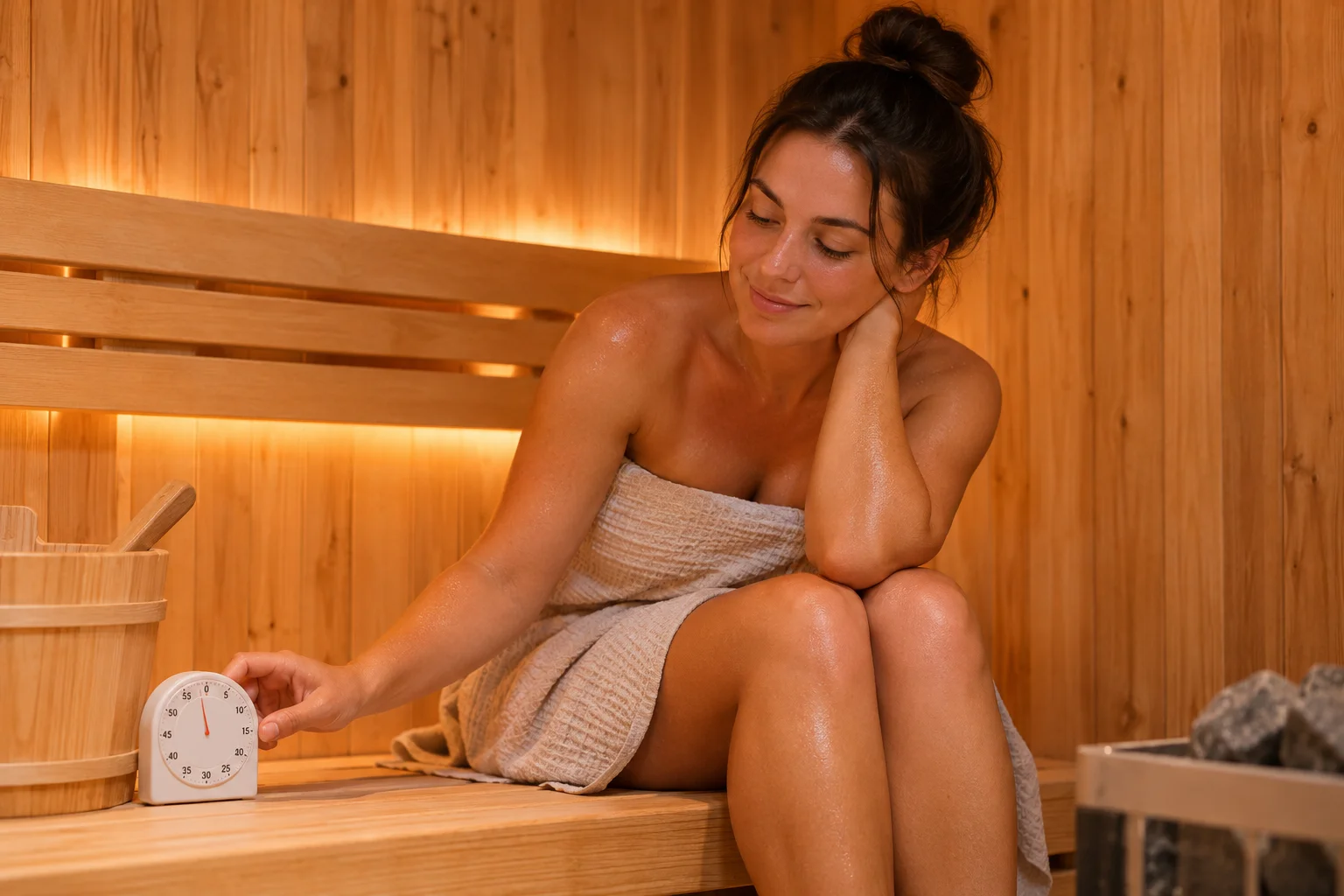
- Set an initial timer if you tend to lose track of time, especially on your first few visits.
- Stand up slowly when leaving the sauna. Heat and dehydration can contribute to lightheadedness.
- Take a real cooling break between rounds. Several minutes at normal room temperature is part of traditional round-based sauna use.
- Skip alcohol before and during sauna use.
- End the session if you feel dizzy, weak, nauseated, short of breath, confused, faint, or simply wrong.
The CDC’s heat-illness guidance lists dizziness, weakness, nausea, heavy sweating, headache, and confusion among warning signs of excessive heat exposure. Those are not sensations to push through for a longer sauna time.
If your reason for sauna is simply to slow down, you may also like House of the Sun’s discussion of sauna and stress relief. Keep the useful part of that idea simple: a calm sauna round does not need to be a long one.
For couples, a longer booking does not mean sitting in the heat continuously. The Spa Date experience is offered in 2.5- and 3.5-hour formats, with sauna or steam as only part of a broader private sequence.
If you are pregnant, have a recent heart attack or stroke, certain heart or blood-pressure conditions, epilepsy, take medications that affect heat tolerance, or have another health concern, ask your healthcare professional before using a sauna. General timing ranges cannot replace individual medical advice.
Frequently Asked Questions
How many minutes in a sauna is enough?
Five to 15 minutes can be enough for one sauna round, especially if you are new or the room is very hot. You do not have to reach 20 minutes. A useful session is one you can finish without dizziness, weakness, nausea, or feeling overheated, followed by a proper cooling break.
Is 30 minutes too long in a sauna?
For a traditional high-heat sauna, 30 continuous minutes is longer than the commonly cited 15 to 20 minute range. If you want more total sauna time, use separate rounds with cooling breaks instead of one long stay. Infrared saunas can use different temperatures and timing, so do not mix the guidelines.
How long should a beginner stay in a sauna?
A beginner can start at about 5 minutes, then leave, cool down, and see how the body responds. If that feels easy across several visits, add a few minutes gradually. Starting short is more useful than trying to match an experienced sauna user’s time on your first session.
How long should you cool down between sauna rounds?
Several minutes at room temperature is a sensible minimum between rounds, and longer is fine if you still feel hot. Traditional Finnish sauna research describes normal-room-temperature breaks between 5 to 20 minute heat exposures. Go back in only when you feel steady, comfortable, and ready for more heat.
Should sauna time be different in a steam room or banya?
Yes. Humidity changes how heat feels, so the same number of minutes can feel very different in dry sauna, steam, or a banya. Use shorter rounds when the heat feels more intense, especially as a beginner. The room conditions and your comfort matter more than copying one fixed number.
Choose the Session, Not the Stopwatch
A good sauna round usually ends before you are desperate to leave. Start around 5 minutes if you are new, work toward 10 to 15 only as comfort allows, and treat 15 to 20 minutes as an upper range for a typical traditional-sauna round rather than a target. If you want the heat to be part of a private, guided visit instead of something you manage alone, book your private session at House of the Sun.