
The infrared sauna vs traditional sauna choice is mostly a choice about how you want heat to feel. Infrared cabins use radiant panels to warm the body at lower air temperatures. Traditional saunas heat the room and stones, and water on those stones can add short bursts of steam. A Russian banya goes further into humid heat, using steam as part of a guided ritual rather than as an occasional extra. The practical differences are temperature, humidity, pace, and ritual. There is no universal winner. The better option is the one whose heat, setting, and session style you actually want.
Key Takeaways
- Infrared saunas warm the body with radiant heat while keeping the surrounding air cooler than most traditional saunas.
- Traditional Finnish-style saunas heat the air and stones. Adding water to the stones briefly raises humidity and changes how the heat feels.
- Steam matters because higher humidity reduces evaporative cooling, so humid heat can feel more enveloping even at a lower air temperature.
- A Russian banya is not simply a steam room. It is a Slavic high-humidity steam tradition built around repeated rounds, cooling, and a venik ritual.
- Choose by heat preference and session style, not by claims that one format can guarantee a specific health outcome.
On This Page
- Infrared Sauna vs Traditional Sauna: The Core Difference
- Dry Sauna vs Infrared Sauna: Heat, Humidity, and Feel
- Infrared Sauna vs Steam Sauna: What Steam Does Differently
- Where a Russian Banya Fits in the Comparison
- Frequently Asked Questions
- Choose the Heat Experience You Actually Want
Infrared Sauna vs Traditional Sauna: The Core Difference
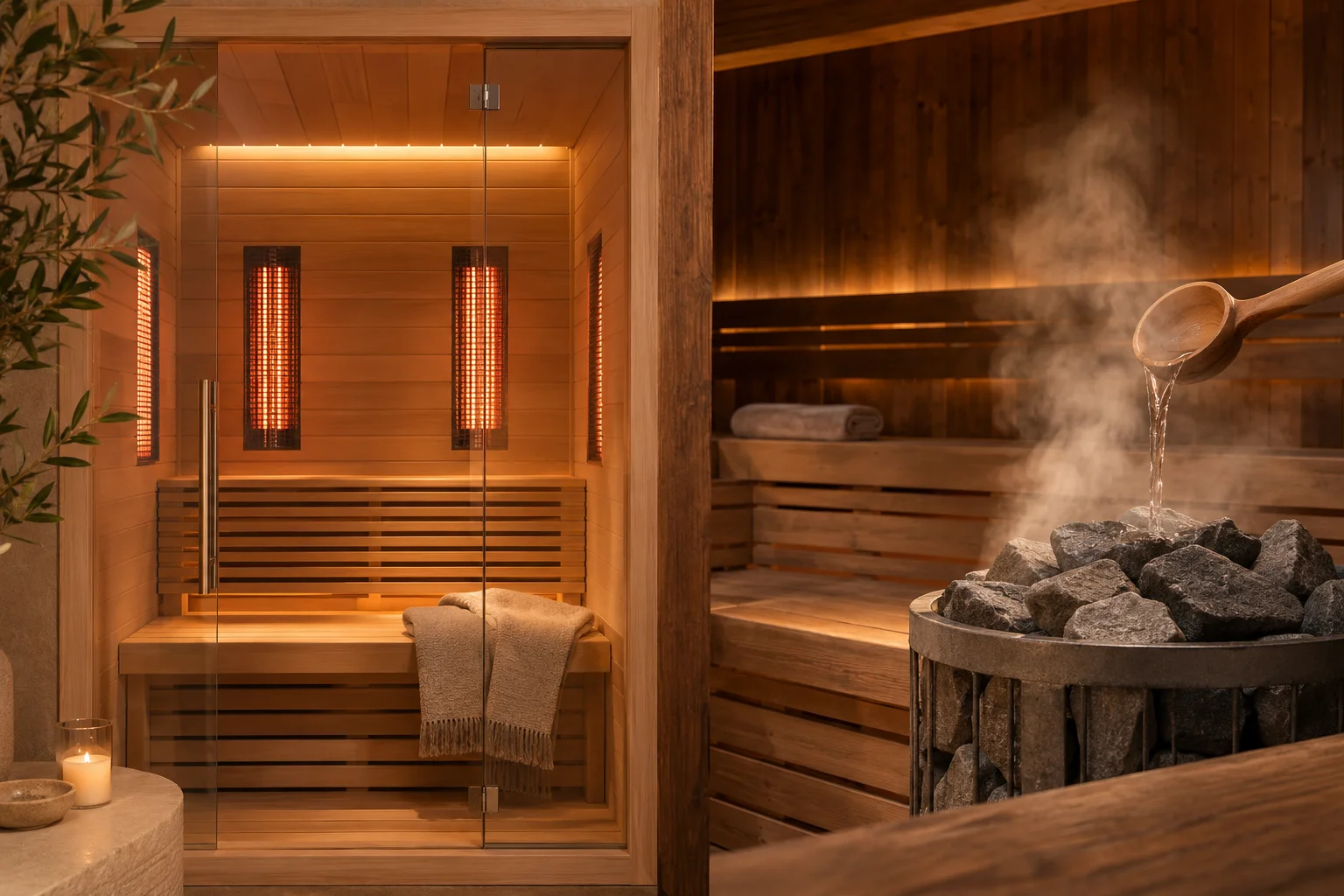
The simplest distinction is the heat source. Mayo Clinic describes infrared saunas as using light to create heat, warming the body more directly without first heating the room to the same degree as a regular sauna. Traditional sauna does the opposite: a heater warms the air and stones, and your body warms inside that hot environment.
That changes the session in three practical ways:
- Infrared usually feels gentler because the air temperature is lower.
- Traditional sauna feels hotter in the room because the air itself carries more of the heat.
- Traditional sauna can add steam by putting water on heated stones. Infrared cabins stay dry.
A systematic review of sauna research describes traditional Finnish sauna around 80 to 100°C (176 to 212°F) with relatively dry air between steam bursts, while infrared sauna commonly operates at lower temperatures. The review also notes that the evidence base is much deeper for traditional Finnish sauna than for infrared. That matters when reading sweeping comparisons online: many claims labeled as general “sauna benefits” were not studied across every heat format.
Dry Sauna vs Infrared Sauna: Heat, Humidity, and Feel
The phrase “dry sauna vs infrared sauna” can be misleading because a traditional sauna is not required to stay dry. A Finnish-style sauna can be used without water, but many bathers ladle water over the hot stones to create steam. The North American Sauna Society makes this distinction directly: traditional sauna users can control humidity with water on the rocks, while infrared rooms do not offer that same steam cycle.
| Feature | Infrared | Traditional Finnish | Steam Room | Russian Banya |
| Primary heat | Infrared panels | Heated air and stones | Hot water vapor | Heated stones, water, and humid steam |
| Humidity | Low | Low to moderate, with steam bursts | Very high | High, central to the ritual |
| Typical feel | Steady, radiant warmth | Hot, dry-to-humid cycles | Soft, saturated heat | Dense steam with repeated rounds |
| Steam | No | Optional | Constant | Core part of the session |
| Ritual | Usually self-directed | Can be simple or social | Usually room access | Guided sequence with venik and cooling |
For someone choosing only by comfort, this is the useful question: do you prefer lower-temperature radiant heat, or do you want the sensation of hot air and changing humidity? If you want to compare the broader experience rather than only the heating technology, House of the Sun’s private sauna experience in Woodland Hills shows the on-site setting where sauna, cold, and other ritual elements can be combined.
Infrared Sauna vs Steam Sauna: What Steam Does Differently
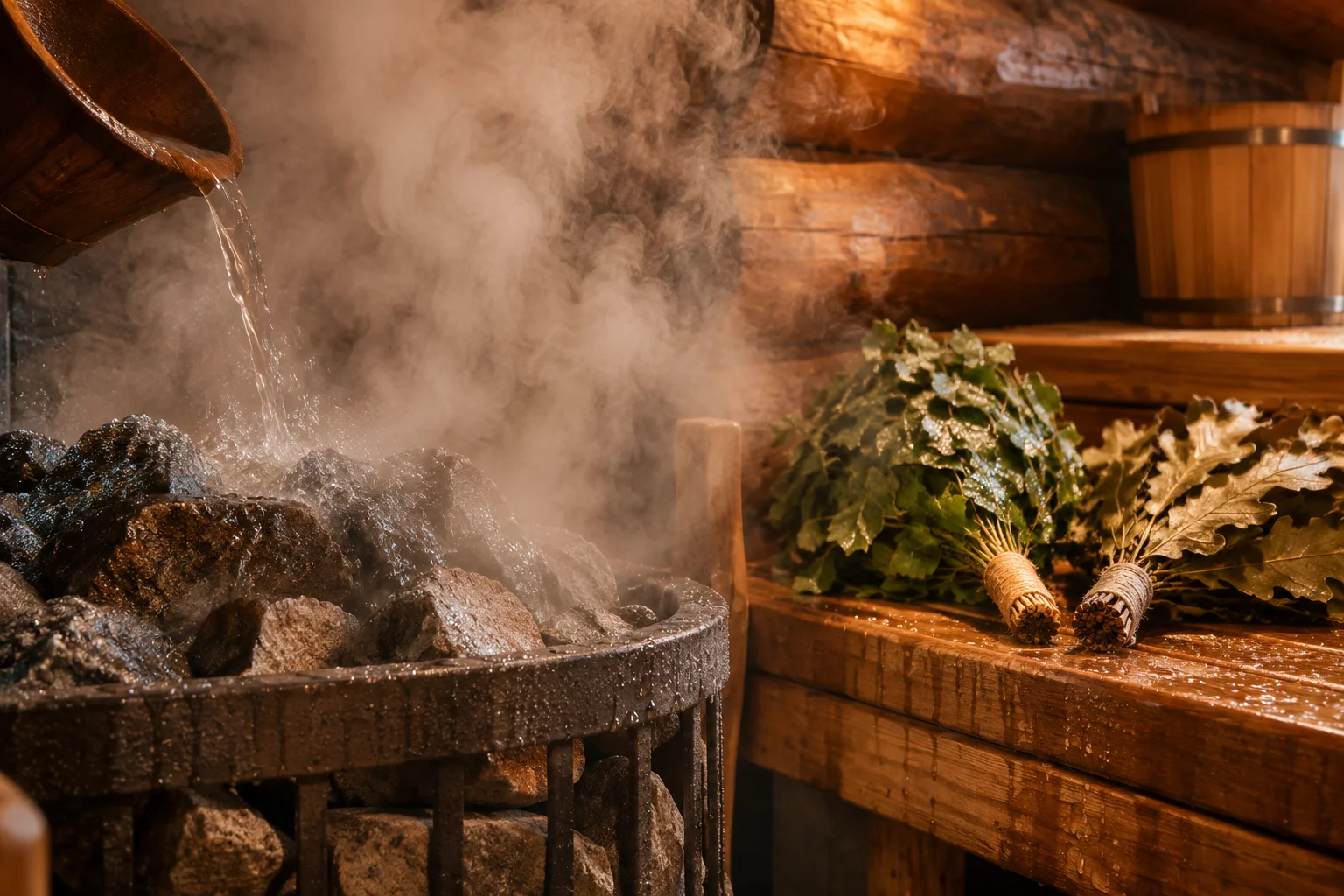
The biggest difference in an infrared sauna vs steam sauna comparison is not simply the temperature on the wall. It is what humidity does to heat transfer. In dry air, sweat can evaporate more readily and help cool the skin. As humidity rises, evaporation becomes less effective, so the heat can feel heavier and more enveloping.
A 2026 study of Finnish sauna bathing found that both temperature and relative humidity independently contributed to physiological heat strain, with temperature still the stronger factor. The researchers specifically noted that higher humidity can reduce evaporative cooling. That helps explain why a humid steam round can feel intense without matching the air temperature of a very hot dry sauna.
What steam changes in practice:
- The heat feels less dry on the skin and in the room.
- The perceived intensity can jump quickly when water hits hot stones.
- Steam makes the session more dynamic. Heat rises, humidity changes, then the room settles again.
- In banya practice, humid heat also gives the venik a role: the bundle of birch or oak branches is used to move warm, moist air across the body.
If your main interest is the experience of slowing down in heat rather than comparing equipment, see House of the Sun’s guide to sauna heat and stress relief. The useful takeaway here is narrower: infrared and steam are not interchangeable because the room environment is fundamentally different.
Where a Russian Banya Fits in the Comparison
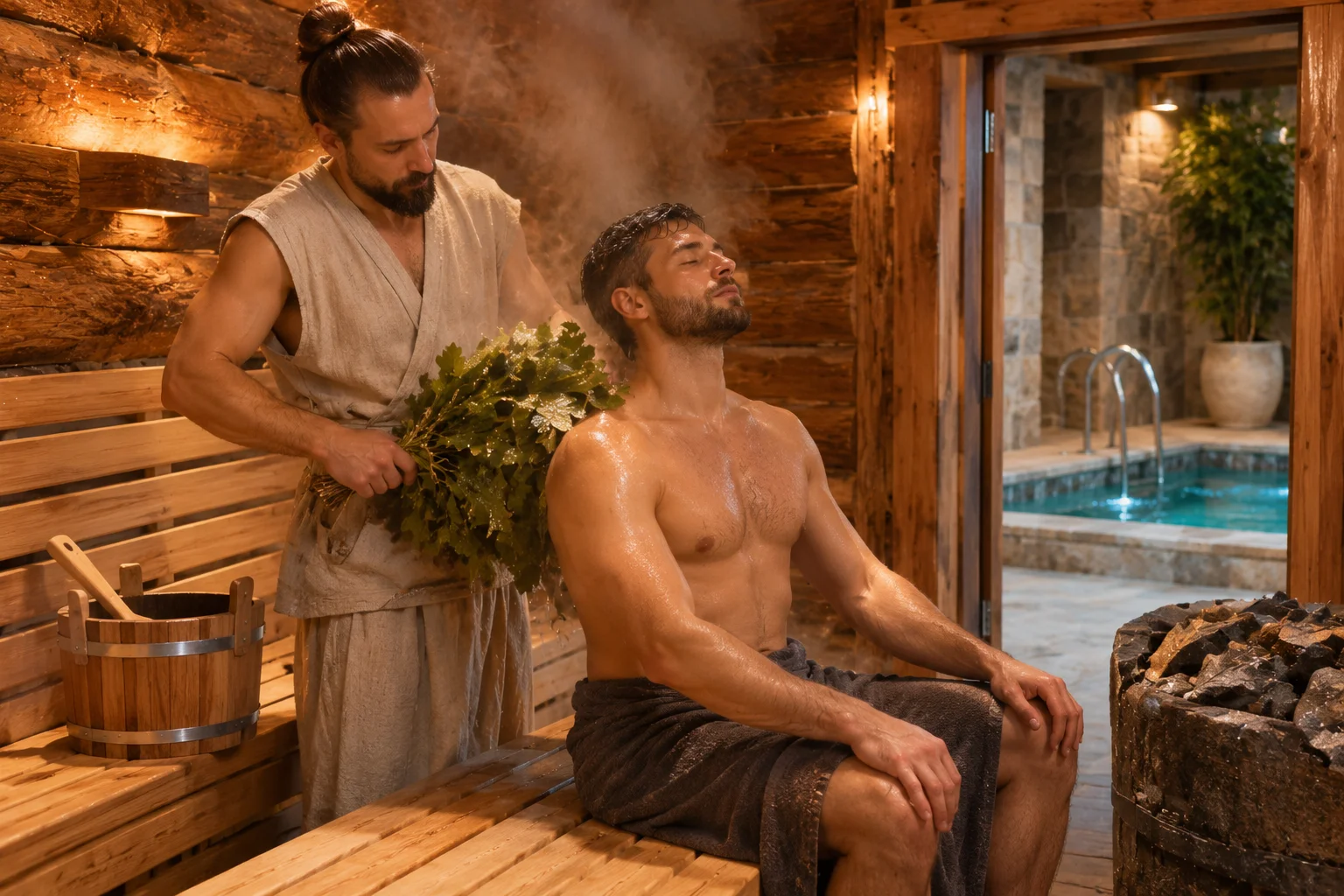
A banya is a Slavic high-humidity steam tradition. It is not simply a hotter room, and it is not the same thing as sitting in a standard steam room. The defining difference is the sequence. Steam, a venik ritual, cooling, and rest are organized into rounds, with another person guiding the pace in a traditional practitioner-led session.
At House of the Sun, that distinction matters because the venue is built around a private guided experience rather than room access. One party uses the property at a time. The steam phase can be followed by a herb infused ice bath or the separate cold pool, and the broader session may include other ritual elements. For couples, the Spa Date experience is one example of how the heat, cold, and shared ritual are structured as a single visit rather than separate amenities.
This is also why the infrared vs traditional sauna question can miss the point for someone comparing an infrared studio with a banya. Infrared is primarily a heat modality. Banya is a heat tradition with a method, pace, and social structure around it. If you want more context on how different cultures build rituals around heat and bathing, House of the Sun has a separate overview of wellness rituals from around the world.
Frequently Asked Questions
Is an infrared sauna better than a traditional sauna?
Neither is universally better. Infrared suits people who prefer lower air temperatures and steady radiant warmth. Traditional sauna suits people who want hotter room air, stones, and the option to add steam. The better choice is the format you enjoy enough to use comfortably and consistently.
Is a traditional sauna the same as a dry sauna?
Not exactly. A traditional Finnish-style sauna can be used dry, but water is often ladled onto heated stones to create short bursts of steam and raise humidity. Calling it only a dry sauna leaves out one of the features that makes traditional sauna different from infrared heat.
Is a banya the same as a steam room?
No. A steam room is primarily a high-humidity heated room. A banya is a Slavic steam tradition built around rounds of humid heat, cooling, rest, and often a venik ritual using birch or oak branches. The sequence and guided method are as important as the steam itself.
Which is better for a first sauna experience, infrared or traditional?
Infrared can feel easier for a first-timer who dislikes very hot air because the cabin usually runs cooler. Traditional sauna gives the classic hot-room experience and can add steam. If you are unsure, start with the style of heat that sounds more comfortable rather than chasing a claimed benefit.
How long should a sauna session last?
Session length depends on the sauna, temperature, humidity, and your heat tolerance. Cleveland Clinic advises keeping sauna exposure around 15 to 20 minutes for many users and starting shorter if you are new. Leave immediately if you feel dizzy, weak, nauseated, short of breath, or otherwise unwell.
Choose the Heat Experience You Actually Want
If you want lower-temperature radiant warmth, infrared is the straightforward choice. If you want hot stones, changing humidity, and steam, traditional sauna is closer. If what you actually want is a private, guided steam ritual with heat, cold, and a venik sequence, that is a different category: banya. House of the Sun offers that experience in Woodland Hills, one party at a time. Book your private session when you are ready to choose the format that fits the way you want to spend the time.